My brother was eaten by cannibals

birch cannibal fork

Object type: fork
Museum number: MAEB:1987.11.622
Description: four-pronged Cannibal Fork made of wood, 290mm x 53mm x 53mm
Findspot:
Materials: wood
Technique: carved
Acquisition Date: 1987
Notes: Donated by the Edgcumbe family (see correspondence file 1987-11-EDG), claimed to be a Fijian cannibal fork

Edgcumbe diary extract

Extract from the transcript of the diaries of Rev C. Edgcumbe.
EDG01/03/b

Tovey letter

Transcript of a letter concerning the death of Lt F. Edgcumbe, written by Midshipman William Tovey to Rev C. Edgcumbe .
EDG01/01/326/b

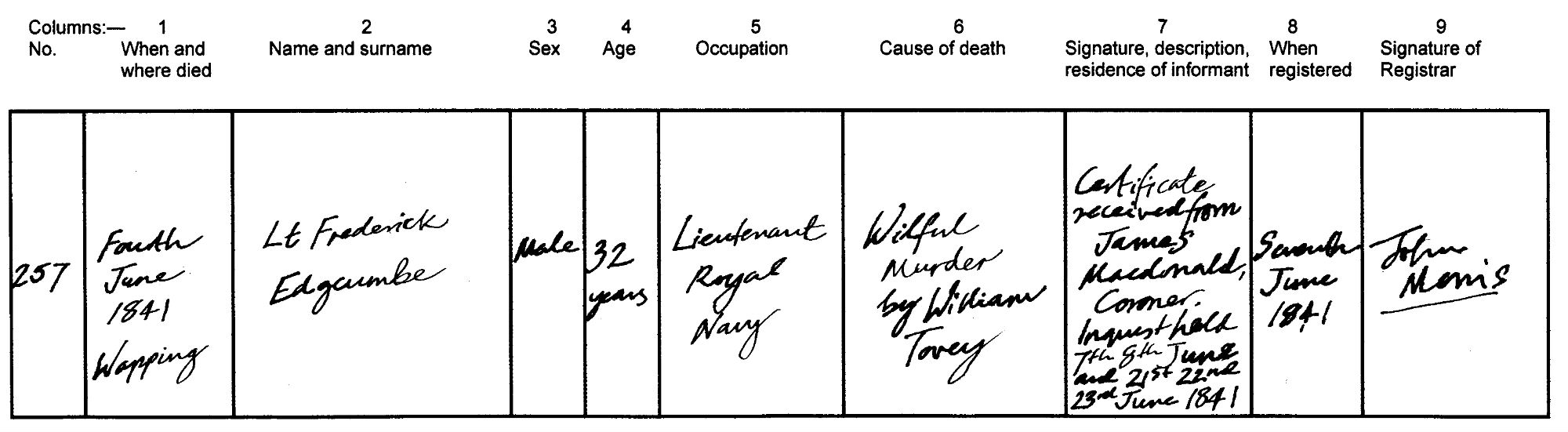
Edgcumbe death certificate

General Register Office. Certified Copy of an Entry of Death (Death Index: District Stepney, vol. II, page 47)


Tovey newspaper story

“Riverside Murder” Times [London, England] 7 Jun. 1841: 6 The Times Digital Archive. Web. 26 Feb 2014

(Blogging Archaeology)

The end of a cherry tree

A friend has recently given me some lengths of cherry wood.  The tree has been cut down to open up an area of her garden, and a second will also be subject to the tree-surgeon’s chainsaw.   I’m fascinated by the changes that the wood is undergoing when cut.   The logs have been “bleeding” while sitting against my workshop wall, exuding a jelly-like sap from the cambium.   The sapwood cuts white and then oxidises to a livid orange colour.

I’ve posted some photos of a bowl that I’ve carved in the cherry, on my Gallery page.   You can glimpse the oxidised interior, which I’ve yet to finish.   As I took the photos shortly after finishing the exterior, the sapwood on the outside is still quite pale.   It’s really interesting to think about these simple, but striking, transformations in raw materials.    Although there are some dramatic transformations evidenced in the archaeological record – from hide to leather, from ore to metal, from clay to pottery – some changes are just as striking and mysterious even though they are simple.   I wonder what people in the past thought about the colours, textures, and smells of wood?

Little Boy Blue’s Bear

Having had to give up with the piece of apple that split so dramatically, I have now finished carving a bear for next door’s grandson, Blue.

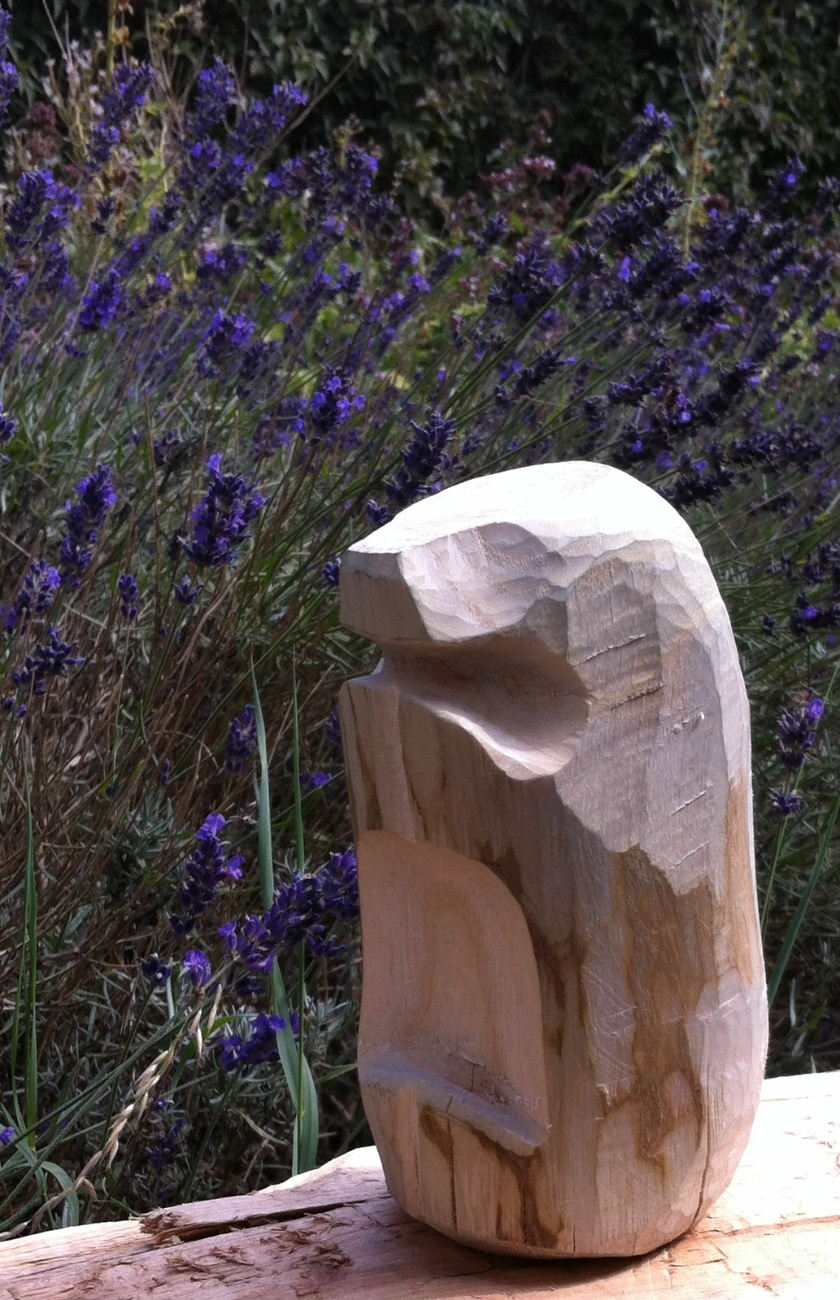
Blue has been asking about his bear ever since I agreed to carve it.   As three-dimensional figures like this are not my forte, it’s taken me a good while to do the job.   At least it does look like a bear, snuffling along the ground.

Small bear on ?sycamore, 2013

Small bear on ?sycamore, 2013

You’ll notice that the wood is very pale.   I was recently given some off-cuts by a friend at work – her dad had helped to fell and reduce a neighbour’s tree and, knowing that I am always after wood, very kindly drove it all the way over from Stroud.   I was told it was sycamore, which is a white wood traditionally used for kitchen ware.   The bark, however, isn’t right for sycamore so I’m not really sure what it is, having not seen the tree.   Nevertheless, it did cut well and I am looking forward to carving the really big log that came into a large bowl.

Problems, problems…

Anyone working in wood will be able to tell you about this…

I mentioned a while back that I had carved a couple of little animals for Ella and Toby, children who live next door.   Toby’s little brother has asked me to carve him a bear – a bear on its hind-legs, roaring, to be precise.   To be honest, I’ve been putting this off.   Partly, it’s because I have a couple of jobs to complete for colleagues in the Education and Events Teams at English Heritage.   Partly (mostly, let’s be honest), it’s because a bear is really hard.   Really hard for me, given that my woodworking is mostly limited to spoons, bowls and other hollow forms, and spindle turning on the pole lathe.

Nevertheless, I thought it was about time I got on with the bear.

My original thought was to base the piece on heraldic bears.   A simplified version of the Warwick bear and ragged staff perhaps, and I did some sketches.   But my carving’s not up to that, so I turned to the bears that I saw at the British Museum’s Ice Age Art exhibition.   The bear is a common motif in both Palaeolithic portable and mural art.   There is an almost complete bear in the ceramic assemblage at Dolni Vestonice, for example, as well as another 20-odd incomplete figures; bear heads from Kostienki 1; and two fabulous bears painted onto the cave wall at Ekain.   I love these two bears for their simplicity – the artist has perfectly captured the form with a few well-drawn lines.

Bear rough-out in apple

Bear rough-out in apple

I cut myself a piece of apple roundwood.   The branch had come from a friend earlier this year, shortly after it had been cut from the tree, and had been standing upright in my store for a few months.   I had started to rough-out the shape of an ambling bear, head down, snuffling at the ground.

The weather has been jolly hot and dry.   The piece of unseasoned apple, freed from its parent branch and divested of its bark, started to dry out very quickly (and unevenly).   The more wood I cut away, the greater the surface area (in relation to volume of wood) became; and the faster it dried.   The inevitable has happened.

Bear rough-out in apple wood

Bear rough-out in apple

A number of radial cracks have developed in the piece.   It took no more than a day for one of these to run the whole length of the bear.    The greatest shrinkage in roundwood like this will always be in its tangential plane, and most quickly from its outside surfaces.   It’s no surprise that this piece has pulled itself apart in this way.   Time to start again…

Bahn, P.G. and Vertut, J. (1988)  Images of the Ice Age   Leicester: Winward PressCook, Cook, J. (2013)  Ice Age Art   London: The British Museum Press

Been away…

Well I notice it’s nearly two months since my last blog post.   I’ve been away, enjoying sunny Denmark!   I had a great time and learnt a huge amount.   The trip has already influenced some of my activities since returning, to do with edged tools – axes, this time – and holding devices.

It’s amazing to me how little attention is paid sometimes by archaeologists to the whole question of what is required to make something.   The concept of the chaine operatoire is making its way out of flint analysis and into other areas.   Even so, it’s really easy to concentrate on different forms of a tool type and loose the bigger picture.

Take holding devices, for example.   This issue really exercises me, because I spend a great deal of time getting my holding devices right so that I can use my tools the way I need in order to complete tasks the way I want to.   They really are essential.

I mean things like benches, dogs, pigs, clamps, brakes, cramps, donkeys, shave horses, vices, claves, holdfasts, grips…the list would go on and on if I further subdivided these classes according to trade or specific task (for example, cleaving brakes, shaving brakes, bending brakes, peeling or rinding brakes).   I regularly use my shave horse and clave, and I’ve just built two pigs inspired by those at use in the boatyard of the Vikingeskibsmuseet in Roskilde.

I’m sure that tools which did the jobs of these holding devices would have been used in prehistory, just as they have been in historical periods and today, especially for woodworking.   They enable a piece to be worked effectively – by which I mean, safely, accurately, efficiently, to attain the desired end result.

The aims of the Bronze Age boat project did not include anything about using prehistoric tools other than the edged tools and plank stitching that was so wonderfully applied at the National Maritime Museum Cornwall (and rightly so, because the experiment design didn’t require it).   But check out the photos and brilliant time-lapse photography in their boatyard.   You’ll see just how important (modern) holding devices were to the build.   Now think about all the materials that you might need, and their configuration, to do a similar job in 2012BC.

Wooden animals

There is a long tradition of whittling or carving little wooden animals in many countries and a wonderful range of techniques is used in their manufacture.  As well as commercial production of toys such as Noah’s Arks and farmyard animals, individuals seem always have whittled little creatures for their own enjoyment and for presents.

The most amazing technique to carve animal shapes that I have come across is in the Erzgebirge region of north-eastern Germany.    Wooden rings are turned on a lathe, cutting the profile of an animal.   Once off the lathe, the ring is sliced up revealing the animal in the section.

My father carved me a small pike many years ago, which I still have on a shelf in my sitting room.   And I have a vivid memory of watching a bodger carve an owl at one of our local agricultural shows (I was perhaps eight or nine years old).   He had a short length of a fairly close-grained roundwood, about two inches in diameter and four inches long.   The owl appeared out of the wood, as though perched on a fence post.  It was all done with a knife until it came to finishing the furled wings on the owl’s back, when the bodger used a little gouge to pick out the effect of the feathers.

This past-time could even be said to go back to the Upper Palaeolithic carvings of animal forms in mammoth ivory, so beautifully displayed at the British Museum’s recent Ice Age Art exhibition.   Were these little figures models, toys, totems, signifiers of group or personal identity, art?

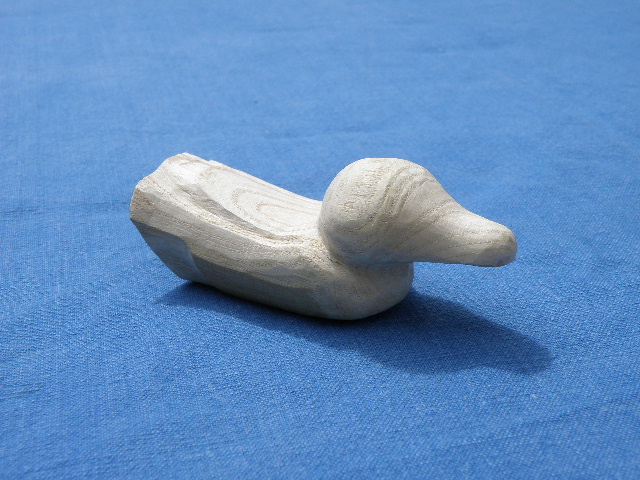
I was asked by one of my neighbour’s daughters to carve her a duck.   I’ve no idea why she chose a duck, but Ellie was adamant that I should make her a duck.   Being my first foray into figurative carving I was a bit nervous.   This is what came out of the little bit of ash that I used:

A duck, carved in green ash.

A duck, carved in green ash.

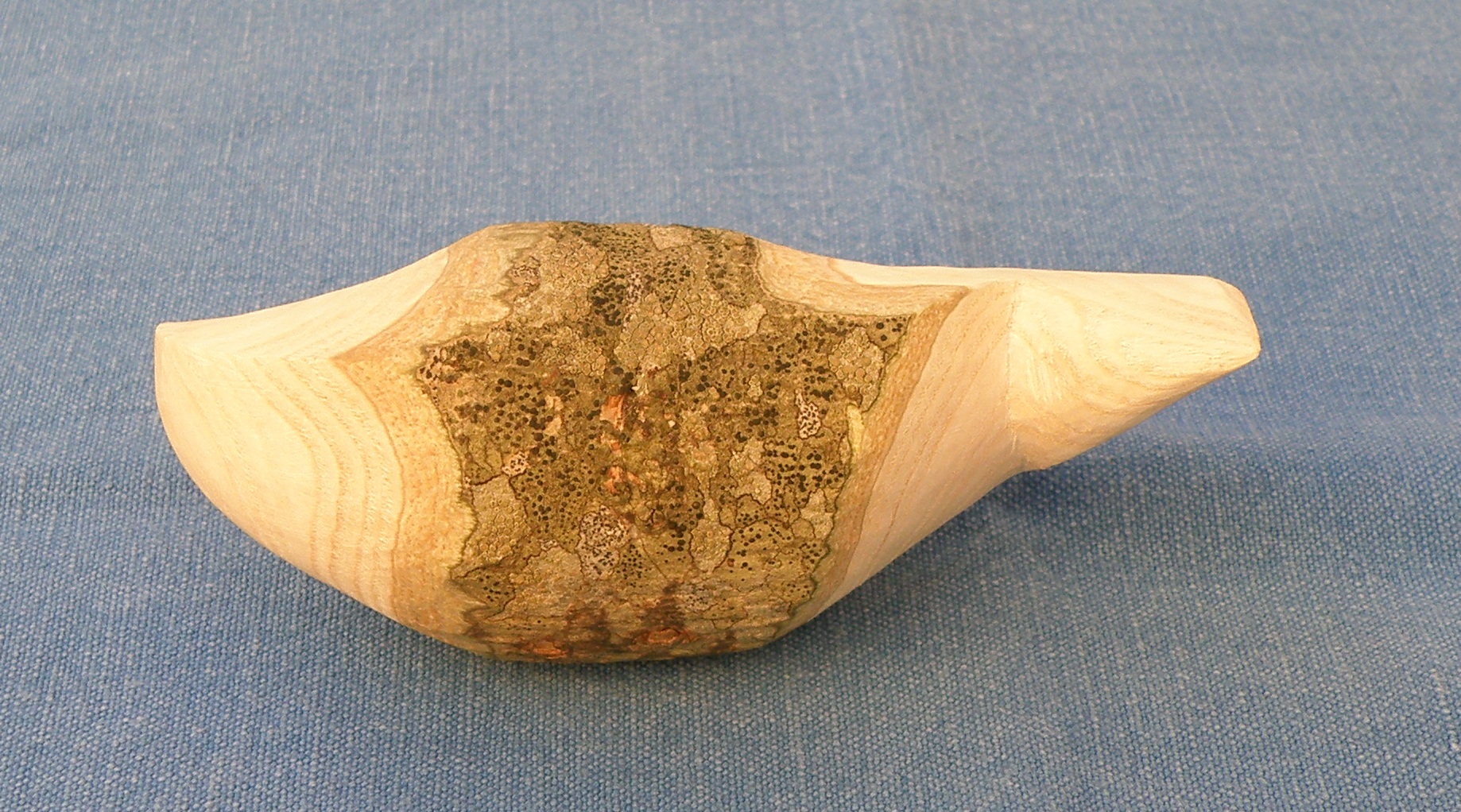
On seeing the duck, the older son of another neighbour asked for a whale.   Toby likes dolphins and whales.   Using the same tools – a straight knife and a spoon knife – on another ash scrap, here is the whale:

A whale, in green ash

A whale, in green ash

The photo doesn’t really show you the shape of the tail, but I’m glad I kept the bark on to suggest the whale’s scarred, barnacle-covered skin.    These are simple, plain shapes and it is interesting to see what the human eye can do to fill in the gaps and identify a form that is suggested by a few lines and planes.

Toby’s little brother would like a bear…

More willow

As part of the process of learning about the characteristics of willow, I carved a large scoop from some of the River Kennet wood that I used to make the bowl in my earlier blog post.

scoop madeof willow

Willow scoop, April 2013

The orange colours have been brought out by the raw cold-pressed linseed oil that I used on the wood.   It’s about 32cm long (bowl about 15 cm, handle about 17cm).   It’s all one piece of wood, carved from half a log.   The back of the scoop’s bowl was at the outside of the log.

Just like the bowl I wrote about earlier, the cleanest cuts were those across the grain.   The smoothest surface is the outside of the bowl.   The handle surface isn’t bad either, except where some fibres were lifted by the cutting edge and tore out.   Cutting parallel to the grain was very difficult to manage.   Even the thinnest of fibres lifted up on the handle, and when I tried to cut or scrape these off, others would lift in the opposite direction.

The interior of the bowl also presented problems.   This was because of the steep sides and relatively sharp angle between the sides and the base.   The willow fibres tended to lift or crush in this area.   Although the upper internal sides of the bowl are quite smooth, the lower sides and base are noticeably rougher.   The narrowness of the bowl meant that I could not place my hands correctly to get the direction of cut I really wanted with my spoon knives.   Perhaps this would have been easier if I had left-handed spoon knives as well as right-handed.

The wood is still relatively green, having been cut about this time last year.   I shall have to leave what I have left for some time before seeing how it cuts when well-seasoned.   In the meantime, perhaps I need to read about how willow is managed for making cricket bats, and whether the different British willow varieties have noticeably different qualities for wood-working.

Learning about willow

There are some really interesting wooden artefacts from the Flag Fen excavations, preserved in the fenny waterlogged deposits.   One of these is a scoop, find reference A8458, carved from a piece of willow.   It was found in one of the lowest levels of the main excavated area of wooden timbers that make up the post alignment and platform of this major prehistoric site.   Associated with Phase 1 structures, it probably dates from around the thirteenth-century BC and is now in the British Museum.

Maisie Taylor analysed the wood from the excavations.    When describing the scoop she wrote, “The bowl of the scoop was shaped across the grain and so well finished that no clues survive as to the method of fabrication” (Pryor 2001:226).

Willow is a fibrous wood with a very open texture.   There are many British varieties and it hybridizes very easily.   The wood can be cut cleanly, but there is a risk that the fibres will tear out; apart from cricket bats, the most common use of willow is its withies for basketry.

With half an eye on the Flag Fen scoop, I’ve been trying out some unseasoned willow that came from a fallen tree in the River Kennet at Lockeridge.   The tree fell across the river and was affecting its course, so the landowner cut it up and I was given a few pieces.

This bowl was very easy to carve, using my small adze and a wide, shallow swept chisel designed for just this work.   However, the long, coarse fibres caused problems in the bowl bottom and where the bottom and sides meet as the chisel’s cutting edge went parallel to the grain rather than across it.   It will be interesting to compare with the behaviour of seasoned wood.   The bowl base is at the centre of the log and the oval form runs parallel with the log.

willow bowl

Willow bowl, March 2013


Pryor, F. (2001)   The Flag Fen Basin   Swindon: English Heritage

My cannibal fork

I recently visited the newly-redisplayed Museum of Archaeology and Anthropology in Cambridge.   Unfortunately I could see only the ground-floor space because of ongoing works upstairs, but it was really impressive nonetheless with some wonderful objects and interesting ideas presented with clarity.   Although the old archaeology galleries in this room showed off a great range of the museum’s collections, the exhibits had got rather tired.   Now the room is full of natural light and beautifully displayed objects.

A case tucked round the corner behind the new teaching space is filled top to bottom with nineteenth-century Fijian cannibal forks.   I hadn’t come across these before, and was intrigued by the smooth, dark wood, elegant prongs and decorated handles of the anthropological objects.   Alongside these are displayed replicated objects, made by members of the Department during a project lead by Alana Jelinek, AHRC Creative Fellow in the Creative and Performing Arts.

The replicated cannibal forks have been carved from white woods including sycamore and ash, so they make a dramatic contrast to the dark, shiny surfaces of the Fijian originals.   The case is illuminated by a video of a making event, with audio of museum staff discussing the forks.   I learnt that cannibal forks are surrounded by controversy, with a rich yet dangerous mythology that has perpetuated barbarous tales of the Fijian people.

A current view is that the forks were nothing to do with cannibalism, but were made to satisfy the curiosity and predilections of collectors who brought them back to European museums.

I took the opportunity to make my cannibal fork, inspired by the beautiful workmanship of the Fijian craftspeople who had carved theirs for the Museum’s Victorian benefactors.   It is made on a piece of cherry from North Farm, West Overton and carved using a hatchet, pushknife and sloyd knife.   Originally I intended to carve beads around the upper handle, but decided to give the fork a face after I saw some footage of the Kingsteignton Idol.   The idol is a wooden Iron Age artefact, excavated in 1867.

wooden cannibal fork

Cannibal Fork in cherry, April 2013